
Home / The Cellar / Heartwood
Heartwood
This is fiction. Everything in the Cellar is made up. Everything else on this site is real.
Gory. Reader discretion. This story contains graphic violence and body horror.
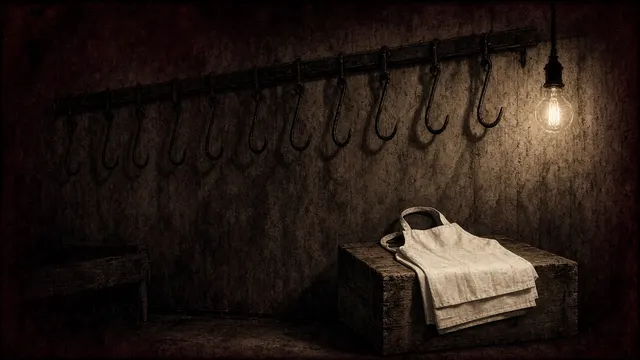
The church on Alder Street had been deconsecrated in 1994 and was being turned into a place that sold expensive candles. My job was the pews. There were twenty-six of them, solid white oak, pegged rather than nailed, and the contractor wanted them stripped and refinished and sold as “reclaimed” to people who would never sit in one.
I got the splinter on the second day. Left palm, below the thumb, from the end of a pew that I should have been wearing gloves to handle. It went in clean and deep, and I could see the dark line of it under the skin like a pencil mark. I tried to dig it out with tweezers and a needle, gave up, and told myself the body deals with these things.
By morning the line was longer. It had crossed the heel of my hand and was heading for the wrist, and it was no longer straight. It had a wobble to it, a long gentle wave, the kind you see in the face of a board when you plane it.
I went to the urgent care place off Route 9. The doctor was young and had the good manners to not touch it with his bare hand. He took an X-ray and held it up to the light for longer than people usually do.
“It’s not showing as foreign,” he said. “It’s showing as, I don’t have the right word. It looks like part of the structure.”
“Of my hand.”
“Of the hand, yes. The lines follow the bones.” He put the film down. “Is it painful?”
It was not painful. That was what bothered me. It itched, a deep dry itch, and when I pressed on the line it gave off a small hard tick, like a joint settling in a cold house.
I tried to cut it out on the fourth night. I am not proud of this, but I am a woodworker and I know what to do with something that has grain. You find the direction of it, and you go with it, not across. I sat at the bench under the work light, laid my forearm on a folded towel, took the razor knife, and opened the skin along the line from the wrist to the first knuckle.
It did not bleed the way skin bleeds. First there was a pale wet seam, then a slow dark amber ooze that smelled of cut green oak and went tacky on the blade. Beneath the skin, where the muscle should have been, the flesh had become fibrous and tight, in long ribbons, and the ribbons were not red. They were the color of a pew after the stain has been scraped off.
I should have stopped there. But I had the knife in, and the thing was moving, a slow rolling shift, like something turning over in a sleep, and the part of me that has spent thirty years separating good wood from bad wood said: get it out. I got the chisel. I set the edge into the seam and tapped it once with the mallet, and the forearm split. It split with a sound I had heard ten thousand times, the dry, satisfying crack of oak giving way along the ray, and the pain arrived all at once like a bill.
I will tell you what I saw because no one else will. I saw rings. The meat of my arm had grown into rings, tight and concentric and brown, around a dark core that had been, I think, my ulna. The rings were not complete. They were wet at the outer edge, still soft, still being laid down. I counted the ones I could see in the light of the work lamp. I got to forty before I had to stop and be sick on the floor.
The doctor stitched me up the next day and was very kind and did not ask for the details. He wrote something in my chart that I was not permitted to read. The splint, he said, was probably unnecessary. I said I would wear it anyway, because it was easier than explaining why the arm was warm.
I have not been able to hold a chisel since. I do not want to. The fingers of my left hand are stiff in the morning and a little pale, and there is a line that runs up under my shirt and over the shoulder and into my neck, and I am told by my sister that when it is quiet in the house she can hear a faint creaking from my side of the room.
It is October. I woke up yesterday and found a small curl of bark in the bed, and under my nails the thin green line of something that was sap but wasn’t. I do not think it hurts. I think it is only patient. I have been reading about how trees do it, how they pull everything inward in the fall and let the outer parts go, and I have been sitting very still, with the lights low, because the books say that the first sign of spring is the buds, and I would very much like to be somewhere without a mirror.
Fiction This story is made up. The people, places and events in it are invented, and any resemblance to anyone real is a coincidence. It is not a true account.