
Home / The Cellar / Twelve Stairs
Twelve Stairs
This is fiction. Everything in the Cellar is made up. Everything else on this site is real.
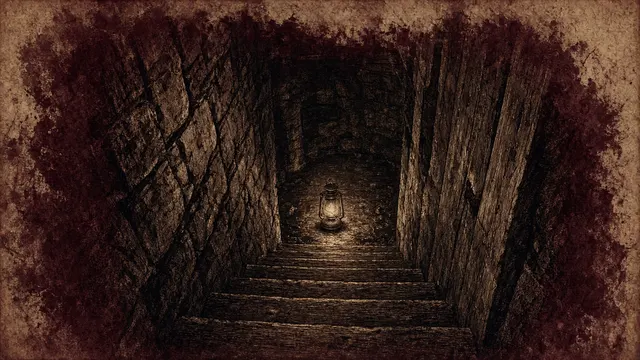
The inspector’s report said: Cellar stairs, twelve. Treads uniform. Handrail loose. I have the report in front of me, so I can tell you that it also said the roof had eight to ten years left, the water heater was original, and there was “no evidence of active pest intrusion.” It was not wrong about anything, as of the day he wrote it.
I bought the house in March from the estate of a man named Arliss Penn, who had lived there for forty years and then, in the way of these things, stopped. The agent said the cellar was “unfinished, with potential.” The agent did not go down there. I noticed that.
The first night I went down for the fuse box. I am not a person who counts things, but the stairs were steep and dark and there was no light switch, only a string, and counting is what you do in a place like that. Twelve. A dirt floor, a furnace, the fuse box on the wall. I flipped the breaker, went up, and counted again to be polite. Twelve.
The second night I went down to check on a smell. Thirteen.
I stood at the bottom for a while, with my phone flashlight, and looked back up at the stairs, which looked the same as they had. Same boards, same loose handrail, same rectangle of kitchen light at the top. I walked up. Thirteen. I counted twice. I considered that I had miscounted. That is a reasonable thing to think once and an unreasonable thing to think every night after.
On the third night I did not go down. I stood at the top with the door open and counted from there, with the flashlight pointed down the throat of it, one at a time, aloud. Fourteen.
I measured it with a tape on a Saturday, and the tape agreed with the count. It did not reset in the morning. Twelve, then thirteen, then fourteen, like a tide that was in no hurry.
I asked the next-door neighbor, a woman named Ruth who waters her lawn at six in the morning and has opinions about everyone. She looked at the house for a long time. “Arliss never let anybody down there,” she said. “He put a lock on the door. On the outside. Then in the last few years he put another one on the inside, which I thought was a curious arrangement.” She turned off her sprinkler. “He used to say he was just keeping count.”
I went home and found the locks. They were still on the door, painted over, which I had assumed were just old hardware. I put the bolt on the kitchen side. I put a chair under the handle. I stopped sleeping downstairs.
By May it was thirty-one. I know because it did not stop being counted. At some point, in the quiet around two in the morning, I started to hear it. It was not footsteps and it was not breathing. It was a low, steady murmur from behind the door, the voice of someone very far down saying the numbers in order, the way you say them to keep your place. Thirty-one. Thirty-two. A pause, as if to listen. Then, patiently, the next one.
I do not think anything is coming up. I want to be clear about that. I think the stairs are what the house does with a person who is paying attention. Arliss Penn paid attention for forty years, and the cellar got as deep as he was willing to follow it, and then one day it was deep enough.
I listed the house in June. The agent was a bright, brisk woman named Carol, who asked about defects and I said, honestly, “the cellar.” She said, “What about it?” I said, “I would not count the stairs.” She laughed, and wrote it down, and then she did what I knew she would do, which is that she went down to look.
I stood at the top and I watched her go. The flashlight on her phone bobbed. I counted along with her, under my breath, as if I could help. She reached the bottom, and called up, cheerful and a little muffled, “Twelve! It’s twelve. It’s a perfectly ordinary cellar, Mrs. Hale.”
I looked at the handrail. It was loose. It had always been loose.
She came up and told me it had good bones, and that she knew a buyer. She looked, I thought, a little too pleased.
I have since moved into a second-floor apartment in a building with no basement. The house sold in July, to Carol, as it turned out, at a price I did not argue with. Ruth still writes me. She says the cellar light is on most nights now, long after midnight, and that the new owner has taken to leaving the door open.
I should have told Carol what I knew. I wrote a note, in fact. It says: “The stairs only change for whoever lives there.” I never sent it. In the margin I wrote the other thing, the thing I cannot stop working out. It began for me on the second night. She closed on a Friday. I have a calendar, and I have been counting.
Fiction This story is made up. The people, places and events in it are invented, and any resemblance to anyone real is a coincidence. It is not a true account.