
Home / Essays / The Dancing Plague of 1518
The Dancing Plague of 1518
In the summer of 1518, people in Strasbourg started dancing and could not stop. The city’s response was to hire a band.
History, not medical advice. This page describes events from the past. It says nothing about what is safe or effective today. For health questions, ask a clinician.
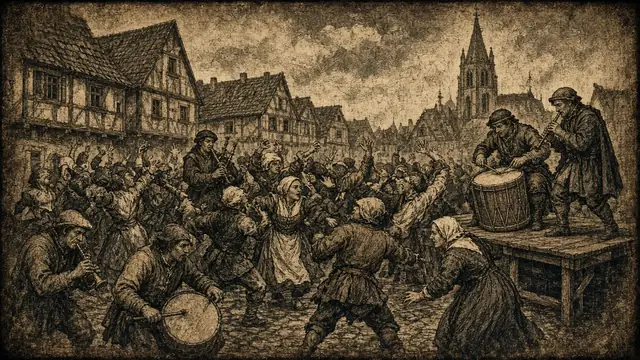
The record is clear on one thing: in July 1518, people in Strasbourg danced, for days, in the streets, and some collapsed from it. Chronicles, sermons, physicians’ notes and the city council’s own orders all agree on that. Almost everything else is argued about.
How it started
By tradition the first dancer was a woman called Frau Troffea. She is said to have started in the street outside her house around 14 July, with no music, and to have kept going for days despite what her husband wanted. Later accounts supply her name, and sources differ on whether the first dancer was named at all, so treat the detail as tradition rather than a court record.
Within days dozens had joined her. By August the count was somewhere between 50 and 400 people, depending on which source you trust. One family chronicle puts it at 400 within a month. Others say less.
The council’s plan
The city turned to its physicians, who said it was a natural illness caused by overheated blood. Their recommended treatment was to dance it out. The council had guild halls cleared and built stages in the horse market and the grain market. Musicians were paid, and healthy dancers were brought in to help.
It did not help. Onlookers mostly took the dancing as a sign that Saint Vitus, a saint believed to be able to curse people with exactly this affliction, was angry. Nobody was free of sin, so more people joined in. The council reversed course, pulled down the stages, and banned public dancing and music.
The cure
The next idea was religious. The worst-affected were put in wagons and taken to a shrine of Saint Vitus at Saverne, west of the city. There, according to the chronicles, they were given red shoes sprinkled with holy water and marked with crosses, and had small crosses put in their hands. Incense and Latin were involved. Word got back that the dancers had been forgiven. The outbreak had faded by September.
Did people die?
Often repeated: about 15 people a day died at the peak. That figure comes from later accounts, not from the Strasbourg records of the time. Those records, as far as modern historians can tell, do not mention deaths at all. Some popular histories say dancers died of strokes and heart attacks, which is plausible after days of exertion but is not documented in contemporary sources. If you see “hundreds died,” read it as unverified.
What caused it?
Several explanations have been offered over the centuries. The 16th-century physician Paracelsus, who visited the city about eight years later, believed Frau Troffea had started dancing to annoy her husband, and that other women copied her for the same reason. This is not taken seriously now.
A modern popular theory is ergot, a fungus on damp rye that can cause convulsions and hallucinations. Historian John Waller argues against it: ergot restricts blood flow to the limbs, and it is hard to see how anyone poisoned by it could dance for days. It also does not explain why outbreaks kept turning up along the Rhine and Moselle, regions with different climates and crops.
Waller’s own view is that this was mass psychogenic illness, hysteria spreading through a population primed for it. Strasbourg in 1518 had bad harvests, disease, political instability and the recent arrival of syphilis, and its people believed Saint Vitus could force a person to dance. Under enough stress and with a belief like that to channel it, he argues, people can fall into a trance-like state and keep going past the point where a body normally stops them. A comparable modern case is the 1963 laughter epidemic in Tanganyika, which spread through a mission school and into surrounding villages.
Waller makes the full case, with the Strasbourg archives behind it, in A Time to Dance, a Time to Die affiliate link by John Waller is a good place to start; he is the historian most popular accounts cite. Prefer a library copy? Try Open Library.
That is the leading explanation, not a proven one. We know they danced. We do not know exactly why, and reasonable people still disagree.
What we know
- Chronicles, sermons and the city council’s own orders agree that people danced in Strasbourg in July 1518.
- The council built stages and hired musicians, then sent the worst-affected to the shrine at Saverne.
- It was over by September 1518.
What we don’t know
- How many died. The “15 a day” figure comes from later accounts, not contemporary records.
- How many danced. Estimates run from about 50 to about 400.
- The details of Frau Troffea’s story, which rests on later tradition.
- The cause. Ergot poisoning is disputed, and mass psychogenic illness is the leading explanation, not a proven one.