
Home / Essays / The Great Molasses Flood
The Great Molasses Flood
In January 1919 a storage tank in Boston split open and sent a wave of molasses down the street. Twenty-one people died. Nobody had to invent anything for it to be strange.
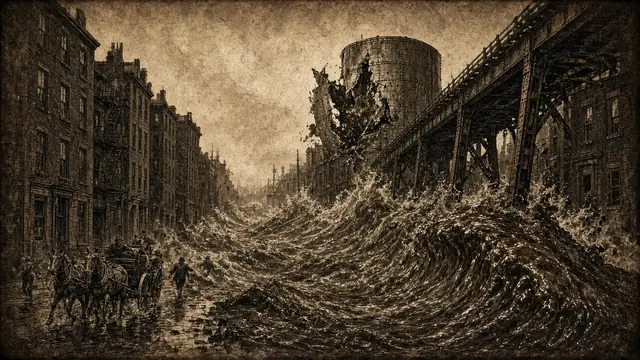
At about 12:30 p.m. on 15 January 1919, a steel tank at 529 Commercial Street, in Boston’s North End, gave out. It stood roughly 50 feet tall, was about 90 feet across, and held something like 2.3 million gallons of molasses. People nearby described a rumble like a passing train. Former soldiers said the rivets popping out sounded like machine-gun fire.
The tank belonged to the Purity Distilling Company, which United States Industrial Alcohol (USIA) had bought in 1917. The molasses was headed for conversion into industrial alcohol, and a good deal of that alcohol went into munitions. The Eighteenth Amendment, which brought in Prohibition, was a day from being ratified.
The wave
What came out of the tank is usually described as a wave 15 to 25 feet high at the front, moving at an estimated 35 miles per hour. Sources disagree on the height, and nobody was standing there with a tape measure. A piece of the tank knocked out one of the supports of the elevated railway, and an approaching train screeched to a stop as the track ahead sagged. It flattened buildings. One reporter wrote that the houses “seemed to cringe up as though they were made of pasteboard.” Several blocks ended up under two to three feet of the stuff.
Twenty-one people died and about 150 were hurt, along with a number of horses. Bridget Clougherty was killed when her house collapsed around her. A boy named Anthony di Stasio was picked up by the wave, carried along it, and woke up to his sisters staring at him. He had been laid out with the dead. Two bodies were found four days after the flood, and they were so coated that they were hard to identify.
Why it was so hard to get out
Molasses is a thick, strange liquid, and it behaves differently depending on how hard it is pushed and how warm it is. The tank had been topped up just days earlier with a fresh load from Puerto Rico, and the weather had turned unusually mild. In 2016, Harvard researchers modelled the event with a scale replica of the neighborhood and corn syrup. They concluded the reports of the speed were credible. They also found that the molasses cooled and thickened fast as it spread, so victims who had survived the first rush were then held in place.
That is part of why rescuers struggled. Police, firemen, Red Cross workers and cadets from a training ship docked nearby waded in, and the effort went on through the night. The search for victims lasted for days.
Cleanup
Crews hosed the area with salt water pumped by fireboats and covered the streets with sand. The harbor ran brown. Molasses got onto boots, then onto streetcar seats, public phones and into homes. One report put it this way: “Everything that a Bostonian touched was sticky.” On the night of 16 January the cleanup crews were ankle-deep in the raw material of rum when church bells started ringing across the city. Prohibition had just been ratified, though it would not take effect for another year.
Who was responsible
USIA first suggested that anarchists had bombed the tank. That was not an absurd idea in 1919, since bombs had hit other industrial sites. The lawsuits ran for about six years, with some 3,000 witnesses. A court-appointed auditor found the tank had failed because it was not strong enough, and that the company was liable.
The details of the neglect are not flattering. Later analysis found the steel walls were too thin for the load, and the rivet holes were where cracks started. Residents reported that the tank leaked and groaned each time it was filled, and children brought cups to collect molasses from the seams. According to engineer Mark Rossow’s account, when a laborer brought shards of the tank wall to the company treasurer as a warning, the reply was: “I don’t know what you want me to do. The tank still stands.”
Want the whole thing, from the testimony to the survivors? Dark Tide affiliate link by Stephen Puleo is a good place to start — it covers the flood, the neighborhood, and the trial that followed. Prefer a library copy? Try Open Library.
Settlement figures differ by source. One account puts the total paid by the company at between $500,000 and $1 million. Another gives $628,000. Both say families of the dead reportedly received about $7,000 per victim. The disaster is also often credited with pushing tighter oversight of construction in the years after, though that is a broad claim and worth treating as one.
What is there now
USIA did not rebuild the tank. The site later became a city park with a playground. The smell of molasses is said to have lingered in the North End on hot days for decades afterward.
What we know
- The tank burst on 15 January 1919 in Boston’s North End and held roughly 2.3 million gallons.
- The flood killed 21 people and injured about 150.
- The company was found liable and paid damages. The site later became a city park.
What we don’t know
- The exact height and speed of the wave. Accounts vary.
- The total paid in settlements. One account says $500,000 to $1 million, another $628,000.
- The precise technical cause of the failure, and how much the company knew or ignored.